
320.7 KB
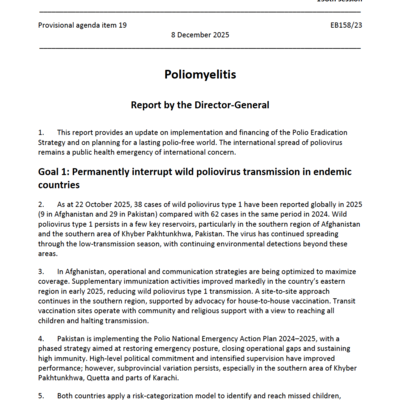
This December 2025 document is the official report submitted by the WHO Director-General to the 158th session of the WHO Executive Board, addressing global polio eradication under provisional agenda item 19. Document EB158/23 represents one of the most authoritative formal updates on the state of the global polio eradication effort. Available in all six official WHO languages.
The report provides a status update on Goal One: permanently interrupting wild poliovirus transmission. As of 22 October 2025, 38 WPV1 cases had been detected globally — nine in Afghanistan and 29 in Pakistan — compared to 62 cases in the same period of 2024. The report details geographic foci of ongoing WPV1 transmission in southern Afghanistan and southern Khyber Pakhtunkhwa, Pakistan, describing operational responses including intensified house-to-house campaigns, transit point vaccination, and community engagement initiatives.
An update on cVDPV2 outbreaks, environmental surveillance patterns, and nOPV2 implementation across WHO regions is included, alongside progress on Goal Two — routine immunization integration, transition planning, and poliovirus containment under GAP-IV. The report highlights funding gaps and frames continued financial commitment as essential. Recommended actions for Executive Board consideration include continued GPEI support, Member State political commitment, and endorsement of specific programmatic adjustments.
Essential reading for WHO Executive Board members, Member State health delegates, WHO senior leadership, GPEI partner representatives, and donor governments monitoring return on GPEI investments.
Who should read this: WHO Executive Board members, Member State health ministers and delegates, GPEI partner organization leadership, senior WHO officials, donor government health attachés, UN system health governance officials.
Document value: Most authoritative formal governance update on global polio eradication, presented to WHO Member States' highest executive body. Critical for sustaining global political commitment and informing resource allocation decisions.
Available in: English, French, Arabic, Russian, Spanish, Chinese