

3.07 MB
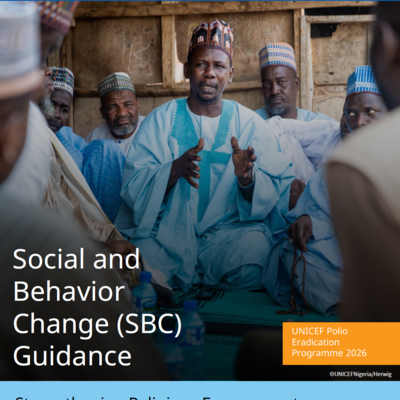
This 2026 guidance, produced by the UNICEF Polio Eradication Programme, is a practical Social and Behaviour Change (SBC) handbook on how to systematically engage religious leaders in polio outbreak response and routine childhood immunization. It positions faith leaders not as occasional messengers but as strategic partners within a broader "trust-building continuum" — intermediaries who shape social norms, risk perception, and caregiver decision-making in the communities where vaccine hesitancy and refusals are most concentrated.
The document is built around five factors for building and sustaining trust between immunization services and communities: engaging trusted male and female influencers within churches and mosques; using communication channels communities already trust; sharing accurate information early and transparently; promoting genuine two-way communication and active listening; and strengthening coordination of public messaging. It then translates these principles into concrete recommendations — formalizing and institutionalizing partnerships, integrating EPI, SIAs and outbreak-response priorities into faith-based action plans, building the capacity of religious leaders, applying gender-sensitive approaches, addressing resistance through dialogue, and resourcing church- and mosque-based activities.
What distinguishes this guidance is its operational, end-to-end design. It maps specific activities for before, during, and after vaccination campaigns, provides an M&E framework for measuring religious leaders' engagement, and closes with an implementation checklist and ready-to-use annexes — religious passages, sample scripts for church and mosque communication channels, and standardized responses to misinformation and rumours. The recommendations draw on lessons learned across multiple countries and a survey of how religious leaders are engaged in 13 countries spanning Eastern and Southern Africa, the Middle East and North Africa, and West and Central Africa.
Document value: A practical, field-ready SBC toolkit that converts global guidance on religious engagement into actionable steps — planning, budgeting, training, and measuring — enabling country teams to build sustained, structured partnerships with faith leaders rather than ad hoc, campaign-only outreach.