

"Why so many doses?" — How Pakistan's Circle of Protection turns confusion into community immunity
Multiple-dose confusion fuels one of the most damaging narratives in polio eradication. Pakistan's response: a two-wave digital campaign and a single visual idea — the Circle of Protection. Here's how it's working.
When parents repeatedly hear that their child needs "another" polio vaccine dose, confusion can quickly turn into doubt.
"If the vaccine worked, why does my child need more doses?"
It’s a question that, left unanswered, fuels one of the most damaging narratives undermining polio eradication efforts.
In Pakistan, UNICEF’s Digital Community Engagement (DCE) unit deployed a two-wave digital campaign in October 2025 specifically designed to address this confusion – not with more facts, but with a new way of understanding what those facts mean.
Rather than launching a single campaign burst, Pakistan’s strategy unfolded in two distinct phases:
Wave 1 (October 14-21, 2025): General vaccination support
The first wave focused on building baseline support for polio vaccination, preparing audiences for more specific messaging to come.
Wave 2 (October 22-26, 2025): Multiple doses content
The second wave delivered targeted content explaining why multiple doses aren’t a sign of vaccine failure – they're how immunity actually works.
By establishing general vaccine confidence first, the campaign created receptive ground for addressing the more complex question of why multiple doses matter.
The Circle of Protection Concept

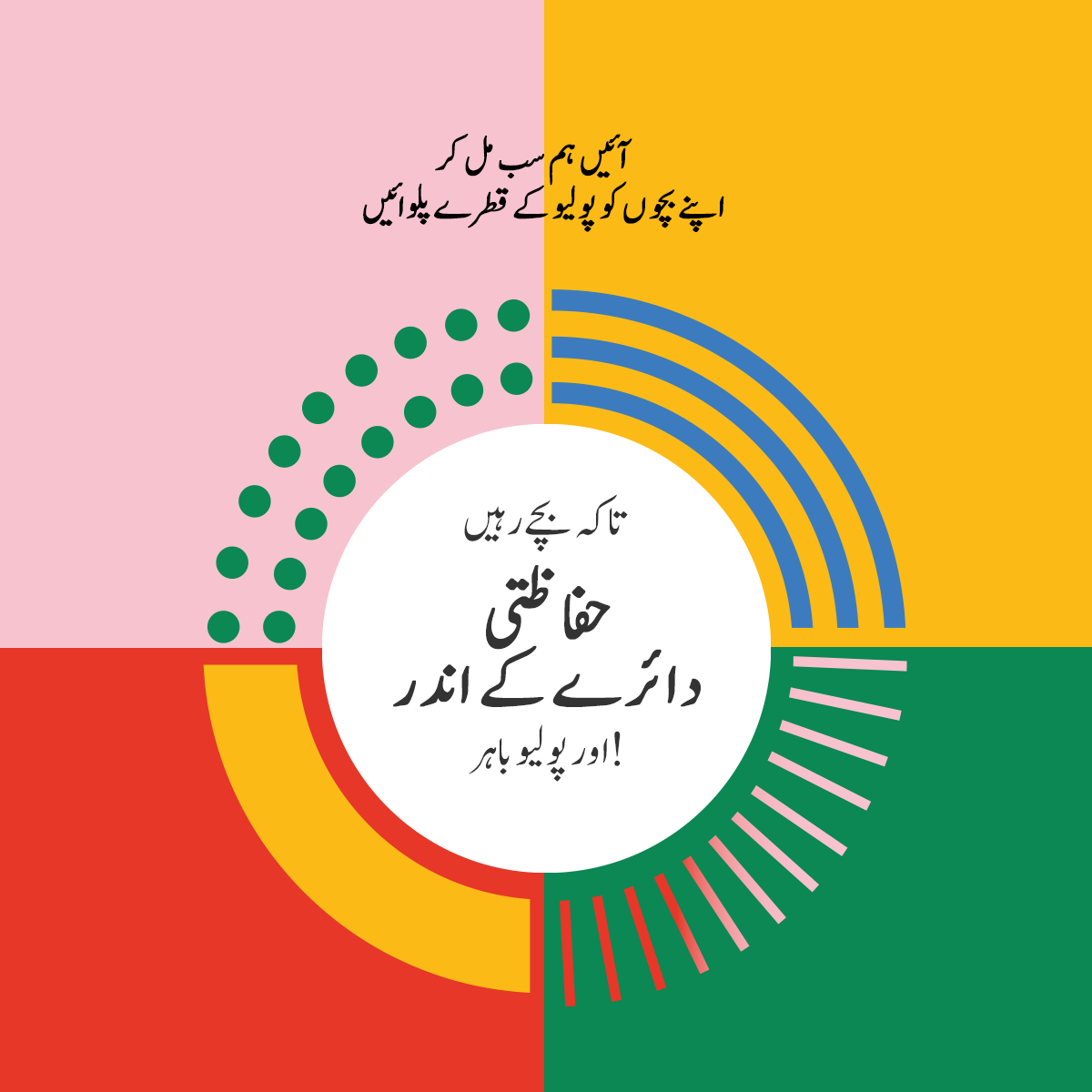
Translation: "Give your children polio vaccine drops and join the Circle of Protection."
Pakistan’s campaign deployed the "Circle of Protection" creative approach – a visual and conceptual framework developed by DCE to make abstract immunological concepts immediately understandable.
The concept is simple but powerful:
- Every vaccinated child = a dot
- Every dose = a ring of protection
- Complete vaccination = an unbroken circle protecting the entire community
- One missed child = a gap where polio can break through
"The Circle makes visible what’s usually invisible," notes the DCE team. "Parents can see how their child’s vaccination doesn’t just protect that individual child – it strengthens protection for everyone."
Why Pakistan Matters
Pakistan is one of only two countries where wild poliovirus remains endemic. More critically, social listening through Polio Pulse identified Pakistan as one of five countries where the most active and influential sources of multiple-dose misinformation originate.
Misinformation that takes hold in Pakistan doesn’t stay in Pakistan. It spreads across digital networks, undermining vaccine confidence in neighboring regions where outbreak risks remain high.

Translation: "Only when every child takes the polio vaccine drops will the Circle of Protection be complete."
An Audience Ready to Learn
The campaign’s timing aligned with another DCE initiative: A Youth Digital Survey gauging vaccine knowledge and information preferences among 18-20 year olds in Pakistan.
The survey findings offer supplementary evidence that audiences are receptive to vaccine information when delivered appropriately:
- 79% of young respondents confidently know what vaccines do
- 75% can specifically explain polio vaccine benefits
- 68% want to learn more about vaccines
- 51% prefer learning through social media platforms
"The survey wasn’t designed to measure campaign impact," says Diana Maria Pirga, Pakistan’s SBC and DCE Specialist, "but it confirms that the audience – especially young people who will soon be parents themselves – is actively seeking vaccine information through digital channels."
The overlap between where young Pakistanis want to find information (social media, delivered through Stories format) and where DCE is deploying content (Meta platforms, using short-form video and carousel posts) isn’t coincidental. It’s strategic alignment based on understanding actual audience behavior.

Translation: "Why is it important to protect children from polio?"
What Success Looks Like
For DCE, campaign success isn’t measured only in impressions and clicks – though those matter. The real measure is whether online conversations shift.
Through Polio Pulse, DCE monitors whether:
- Questions about multiple doses are being answered more effectively in online spaces
- Parents are sharing the Circle of Protection concept in their own words
- Vaccine confidence indicators are strengthening rather than eroding
- Misinformation narratives are losing traction
"We can see in real-time whether the messaging is landing," explains Emanuele Cidonelli, DCE Specialist from UNICEF NY HQ. "If we see a question appearing repeatedly across multiple platforms or regions, we know we need to adjust the content or create additional resources addressing that specific concern."
This feedback loop – deploy content, monitor response, adjust strategy – distinguishes rapid-response digital interventions from traditional awareness campaigns that measure impact months after the moment has passed.

Translation: "That is why, after multiple doses of the polio vaccine, a Circle of Protection is formed that keeps children and their families safe."
Beyond Pakistan
While Pakistan’s campaign addresses a specific national context, the approach offers a replicable model for other countries confronting similar multiple-dose confusion.
The Circle of Protection campaign is simultaneously deploying across Kenya, Nigeria, the Democratic Republic of Congo, and Ethiopia – each with locally adapted creative assets and culturally relevant messaging, but all using the same conceptual framework.
"The core insight – that multiple doses build collective protection – translates across contexts," notes the DCE team. "But how you communicate that insight needs to be adapted for local audiences, local languages, local digital behaviors."
Pakistan’s two-wave approach may also inform future campaign strategies. By establishing general vaccine confidence before addressing specific misconceptions, the campaign creates more receptive conditions for complex messaging to land effectively.


The Work Continues
As Pakistan’s campaign concluded its second wave, DCE was already analyzing what worked, what didn’t, and how the strategy can be refined for future deployments.
The final results will inform not just Pakistan’s ongoing communication efforts, but how the global polio program addresses one of its most persistent challenges: helping parents understand that multiple doses aren’t evidence of vaccine failure – they're how immunity works.
And the indicators are encouraging. The Circle of Protection is resonating. The two-wave approach is performing well. And the conversations online are beginning to shift.
"We won’t know the full impact for several weeks," Emanuele acknowledges, "but what we're seeing so far suggests we're addressing the multiple-dose confusion in ways that are actually connecting with parents."
Because ending polio requires more than delivering vaccines. It requires communities who understand why those vaccines matter – and why every dose counts.
Pakistan’s multiple-dose campaign is part of DCE’s rapid-response digital interventions for polio eradication. Learn more about real-time social listening at Polio Pulse.