

The silence that wasn’t silent: rapid deployment of community listening during Tanzania’s Polio Campaign
Tanzania is often considered a stronghold of immunization success.
Vaccination coverage is consistently high. Trust in institutions remains strong. Community health workers are known, respected, and present in people’s daily lives. Campaigns are familiar, and acceptance is the norm.
And yet, when the country launched its latest polio campaign, something did not fully align.
By Emanuele Cidonelli, UNICEF Digital Community Engagement Specialist
Mwanza, Tanzania — March 2026
Before the campaign: a signal, and a gap
The trigger came from the environment.
Poliovirus was detected in wastewater in Mwanza—an early warning of silent circulation, despite no confirmed human cases. The response was immediate: a nationwide campaign targeting 6.7 million children, launched on March 24.
Vaccinators moved through homes, schools, markets, and transport hubs. Radio messages echoed across communities. Leaders mobilized. The system activated at scale.
A Digital Community Engagement specialist from UNICEF Global Polio team was deployed a few days before the launch of the campaign to support the rollout.
Online, the campaign appeared coherent and steadily controlled. Across dozens of online platforms, social listening showed strong, consistent messaging. Government institutions, media, and health authorities were dominating the narrative, reinforcing safety, urgency, and national coordination.
But one layer was missing. Community voices.
A warning was immediately issued: the system was capturing what institutions were saying, but not what people were thinking.
Online monitoring suggested in fact a stable environment. No major spikes in misinformation. No visible resistance. And yet, the dataset itself carried a warning: it was heavily weighted toward institutional communication while community voices were missing from the landscape.
The situation did not seem to concern the campaign organisers, but at UNICEF DCE unit we know this is the indicator that requires attention and increased investigation.
The absence of community voices in such a sustained and institutional-driven debate does not mean they have nothing to say. Although online media in Tanzania are accessible to only 33% of the population, and only 9.7% of them are on social media, institutional accounts still represent a small and insignificant fraction of them. In every country, with different scales and roles, civil society – journalists, radio and TV speakers, media persons, activists, health specialists, students, teachers, and caregivers – owns a share of voice digital on online platforms. Their feeds carry messages that travel across borders and channels, and they act as a bridge between the online and the offline voices of their communities.
If those voices were silent in Tanzania’s online debate, that could only mean one thing: they were speaking somewhere else. And it was there that the first signs of friction emerged.
Two realities for the same community
On the first day of the campaign, the gap became visible.
Vaccination teams began reporting refusals.
They were limited, but unexpected, particularly in a country like Tanzania, where refusal is not the norm.
Online, however, nothing had changed. No spike in misinformation. No visible resistance. The narrative remained overwhelmingly positive.
It’s like two realities were unfolding in parallel.
One visible. One not.


Rapid deployment of integrated community listening
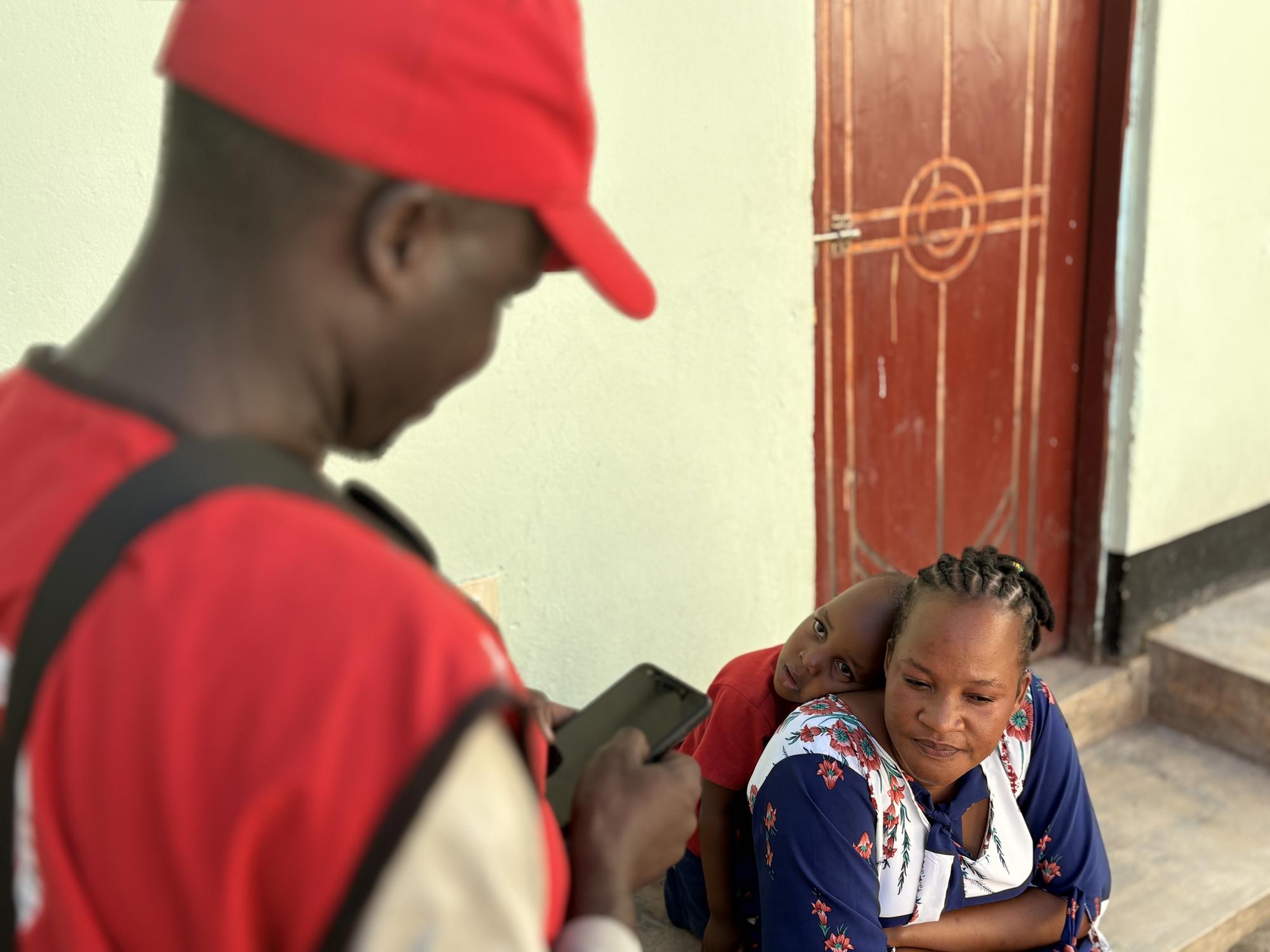
The response was immediate. Working with Tanzanian Red Cross, the Digital Community Engagement rapidly deployed its community listening tools. By processing standardised templates connected to the AI-served social listening infrastructure of Polio DCE, the programme is able to deploy in less than 24 hours a country-tailored tool that can work on any mobile device, without any connectivity, and more importantly, without training requirements for their use. By the end of day 1, the tool had already been deployed through a simple link on the mobile phone of tens of Red Cross volunteers spread across the 7 regions.
By Day 2, the first signals already began to emerge, and the pattern described by the feedback collected through the entire week was already clear. Communities were talking about the campaign, and their issue was not rejection. It was information. In fact, caregivers were not refusing because they distrusted the vaccine. They were hesitating because they did not feel sufficiently informed. Many had not understood why the campaign was happening, why multiple doses were needed, or why urgency existed in the absence of visible cases. The most consistent feedback was simple: Information arrived late.
At the same time, another issue surfaced—less visible, but equally important. Those expected to explain were not always fully equipped. In Mwanza, a school principal expressed it directly: “How can I advise and convince parents if I don’t understand myself?”
The challenge was no longer about messaging alone. It was about how that message moved through the system.
A campaign built on people
Polio eradication is not only a medical effort. It is a community one. In Tanzania, the campaign mobilized a wide network: doctors and nurses, social mobilisers, town criers, teachers, community and religious leaders—and ultimately, children and their caregivers. Each plays a role in carrying information, building trust, and enabling decisions. This human infrastructure is the backbone of success.
It is also where gaps become visible. While vaccinators were widely praised, seen as respectful, present, and able to explain the vaccine, social mobilization did not reach all households with the same consistency. Many families encountered the campaign for the first time when vaccinators arrived at their door. By then, the decision had to be made immediately.

The information gap
Community feedback made the pattern clear. This was not a campaign facing widespread misinformation. Only a minority reported hearing rumors, and overall perception of the vaccine remained strongly positive. But information was uneven.
Some caregivers lacked basic understanding of polio as a disease. Others were unclear about the purpose of repeated doses. Many had not heard about the environmental detection that triggered the campaign.
The issue extended beyond communities to the system itself. Coordination among social mobilizers, those responsible for translating national messaging into local understanding,was not always strong enough to ensure consistent, timely, and clear communication.

The invisible challenge
At the center of the campaign was a difficult concept to communicate: Act now, before the disease appears.
Environmental detection is a technical signal. It requires translation into everyday understanding. Without that translation, the absence of visible illness can reduce perceived risk.
This dynamic does not always appear online. It emerges in conversations. And those conversations were largely happening outside the reach of digital monitoring—through word of mouth, local networks, and closed channels.

The following week: from insight to action
In the days that followed, the response shifted from detection to coordination.
A national training on social listening and misinformation management was delivered, bringing together government and partner teams.
The focus was not on introducing new systems, but on strengthening what already existed.
Using real campaign data and field evidence, participants worked to align tools, roles, and processes—connecting digital monitoring with community feedback, and ensuring that insights translated into action.
Recommendations focused on:
- Integrating daily community feedback into national monitoring
- Strengthening coordination among social mobilizers and frontline actors
- Equipping vaccinators, teachers, and local leaders with simple, consistent explanations
- Establishing clearer pathways to escalate and respond to emerging concerns
The objective was practical: ensure that the next campaign round in May would not face the same blind spots.
What the campaign revealed
The Tanzania campaign did not expose a failure of trust. It exposed the limits of assuming that trust alone is enough.
Acceptance remained high. Most households vaccinated their children. Communities largely supported the campaign. But the pathway to that outcome revealed a gap.
Awareness was not always timely. Information was not always clear. Listening was not always complete. In many cases, acceptance depended on the interaction with a trusted individual at the last mile.
That is a strength. It is also a risk.
Beyond the dashboard
The lesson is not about replacing digital tools. It is about completing them to make sure they can do what they are expected to. Online debate described what was visible: structured narratives, institutional messaging, public discourse. Community listening revealed what was felt: questions, uncertainties, gaps in understanding.
Both are real. But only together do they form the full picture.
In Tanzania, the turning point was not the emergence of refusals. It was the recognition that they had gone unheard, until they appeared in action. As the country prepares for the next phase of its polio response, the priority is clear. Not only to reach every child. But to listen, early and widely, to how national strategies and communication programmes are translated into community decisions.
Polio eradication is first and foremost, a collective achievement. Every voice must be engaged. And every voice must be heard.